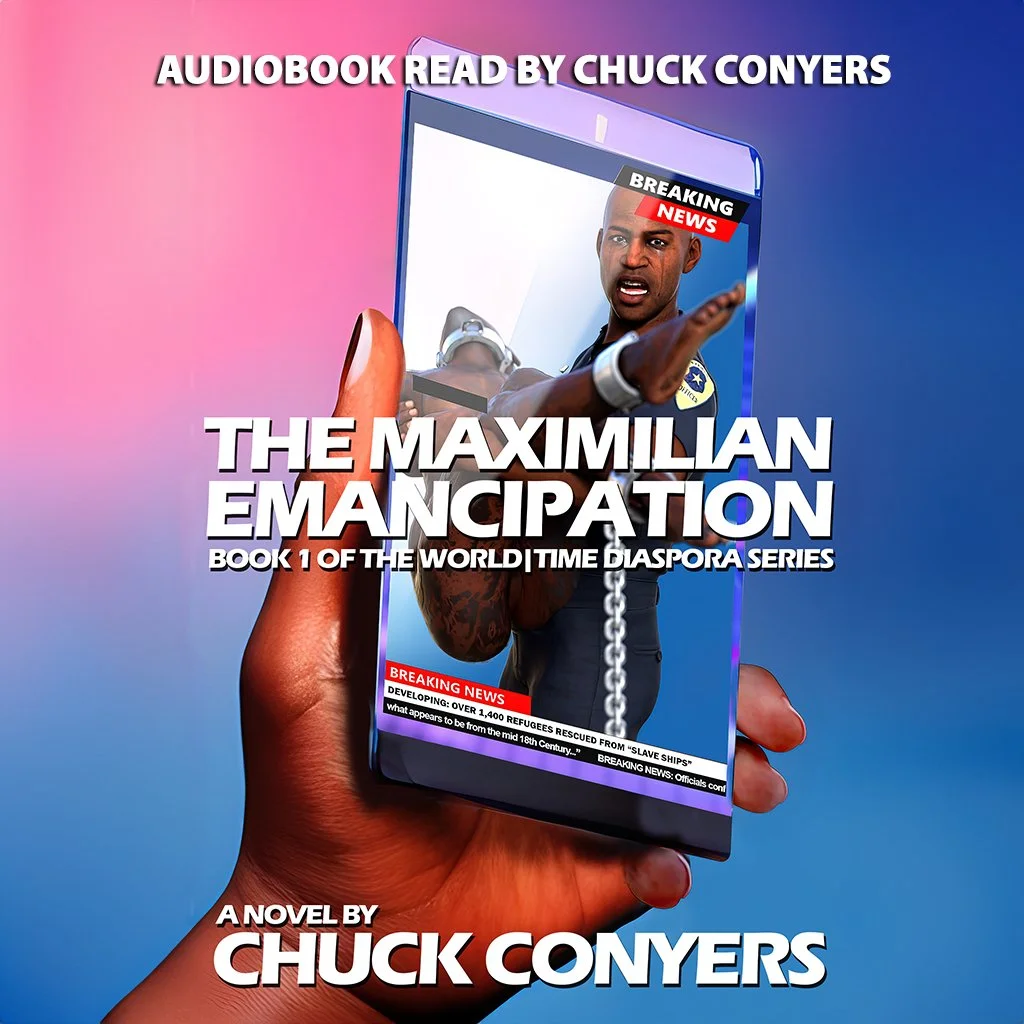
It's the summer of 2041, and America is already approaching a breaking point when the impossible happens: three African slave ships suddenly appear in the waters between New York and New Jersey.
The ships—and the people aboard them—have somehow traveled from the era of the transatlantic slave trade into the modern world.
A team of scientists, academics and government officials is assembled to understand what happened, including Maximilian Oroko, a Nigerian-born historian and African-language specialist. But the mystery extends far beyond 2041, connecting a 17th-century African warrior, an increasingly divided future America and events centuries further into the future.
Part science fiction, part historical drama and part political satire, The Maximilian Emancipation ultimately asks an enormous question:
If you could go back in time, could you prevent African slavery?
The Maximilian Emancipation was my first novel, but the story existed long before I became a novelist.
I originally developed the idea with the instincts of a filmmaker and spent years expanding its characters, history and world. I attempted to turn it into a screenplay before realizing that the scale of the story had outgrown what I could realistically make—or, at the time, even imagine getting produced. Writing it as a novel finally gave me the freedom to tell the story at the size it demanded.
Years later, I returned to the material again to create the audiobook edition.
That meant translating a story spanning different historical periods, locations, characters and perspectives into an experience that had to work entirely through sound and performance. Rather than simply treating the audiobook as a recording of the text, I approached it as another adaptation of the same underlying story—using performance, pacing and audio production to give the world a new form.
There's an interesting circularity to the project for me. A story that began with my desire to make something cinematic became the novel that turned me into a published author, and the audiobook allowed me to bring performance and production back into that world in a completely different medium.